
Digital shop
Resources built for your students and your individual needs.
Browse by what you need.
Start here
Get started with the basics
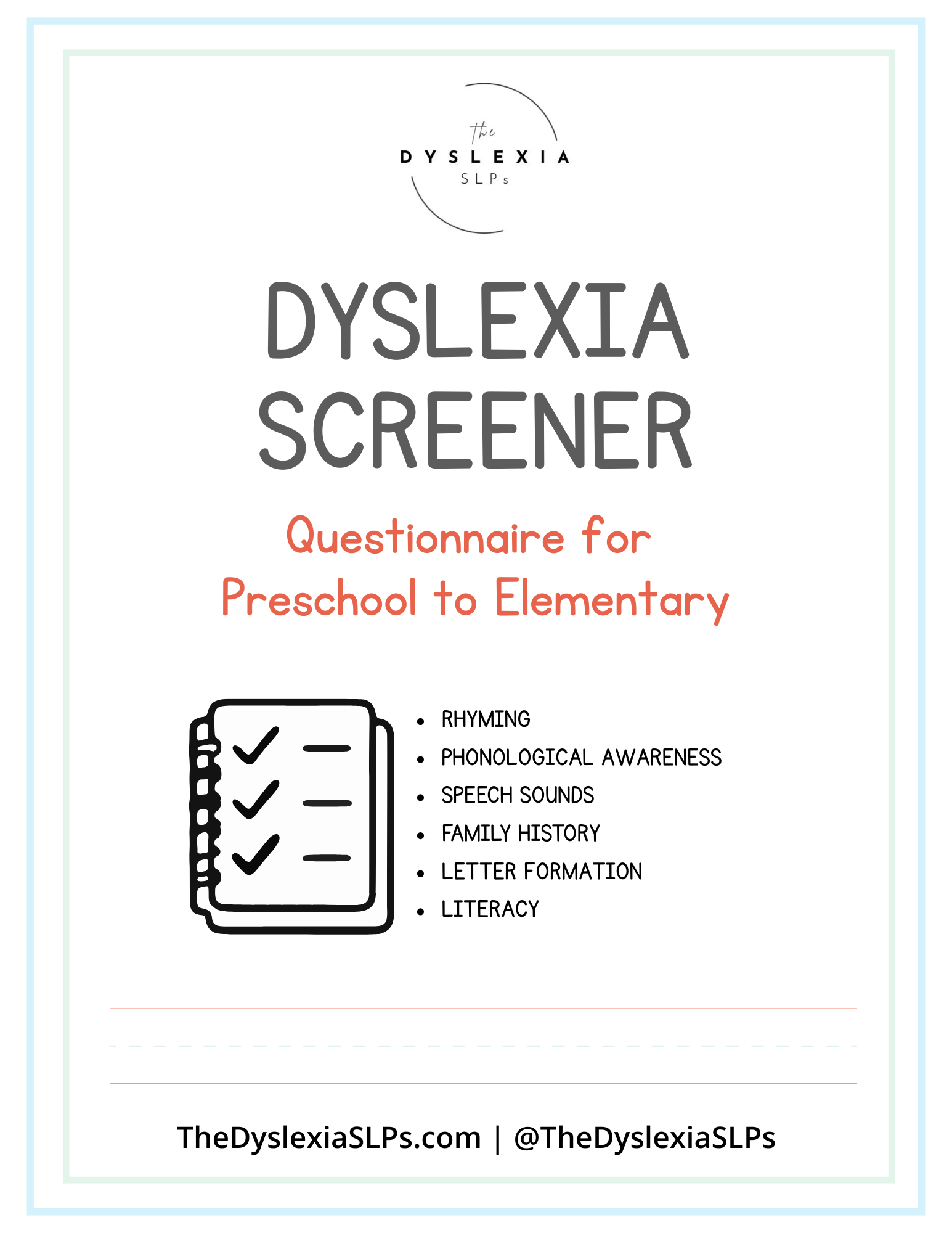
Don’t know if you should be assessing a child for dyslexia? Use this free screener as a first step to determine whether a full assessment is warranted!
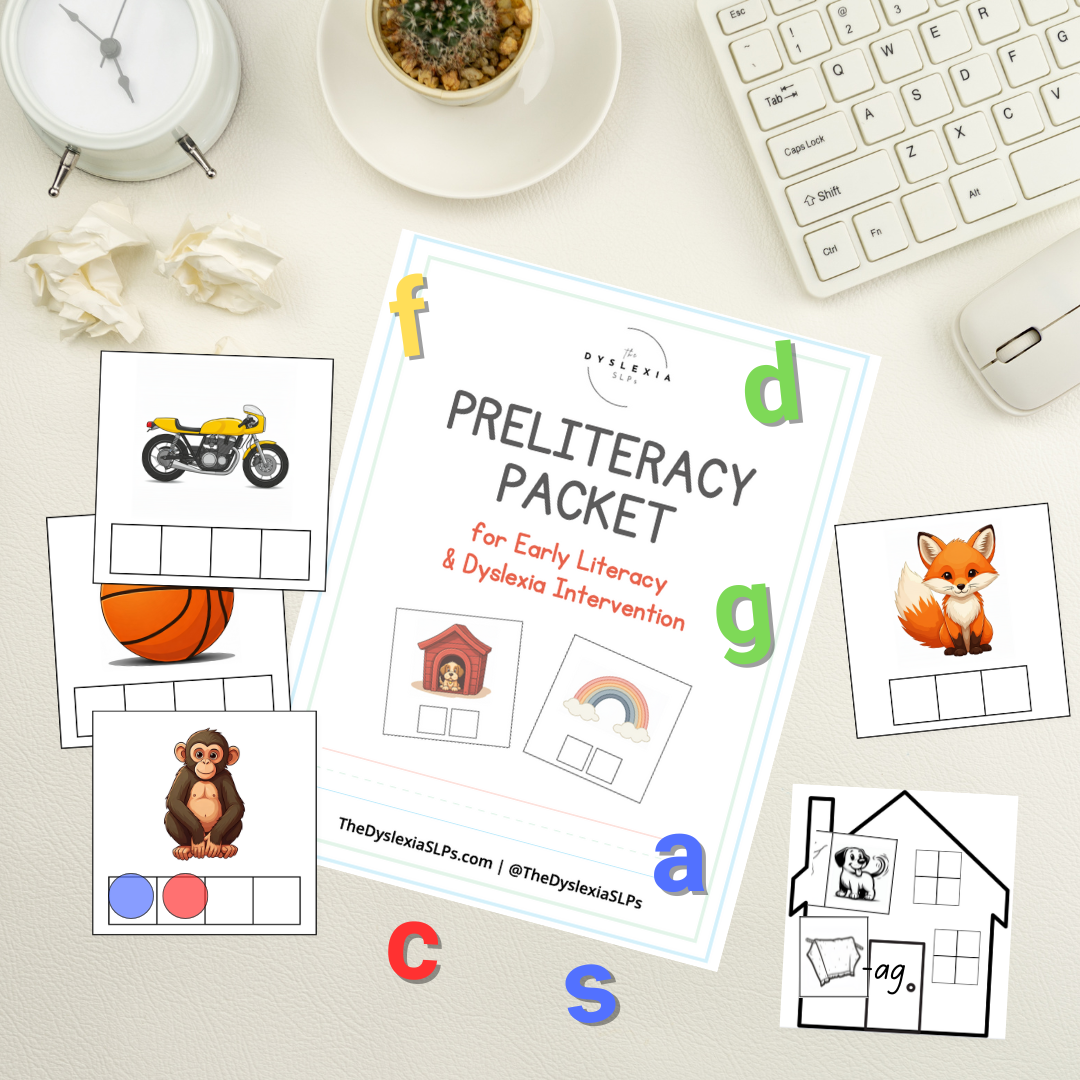
This literacy guide is designed for preschool and early elementary students (ages 4-7) who have been diagnosed with dyslexia or identified as at risk and who lack the phonological awareness skills necessary to begin learning to read and/or spell. These are the students who often face significant reading challenges, making early identification and intervention critical.
We believe it is essential for pediatric speech-language pathologists to be vigilant in identifying dyslexia and to incorporate literacy into their practice. Early literacy intervention is not only highly effective—it is engaging, rewarding, and powerful to witness as students begin mastering foundational skills that support long-term reading success.
This guide is appropriate for:
Students diagnosed with or at risk for dyslexia
Preschoolers who need explicit phonological awareness instruction before reading
School-aged students who lack basic phonological processing skills
Skills Covered
Rhyming – Identifying and producing rhyming words
Syllable Counting – Counting, segmenting, and blending syllables
Beginning Sounds – Recognizing and matching initial phonemes
Phoneme Blending – Combining sounds to form words
Phoneme Segmentation – Breaking words into individual sounds
Phoneme Manipulation – Adding, deleting, or substituting sounds
Letter–Sound Correspondence – Connecting letters with their sounds
To support early identification, we encourage clinicians to utilize our free Dyslexia Screener, available on our website, to help determine which students would benefit from this intervention.
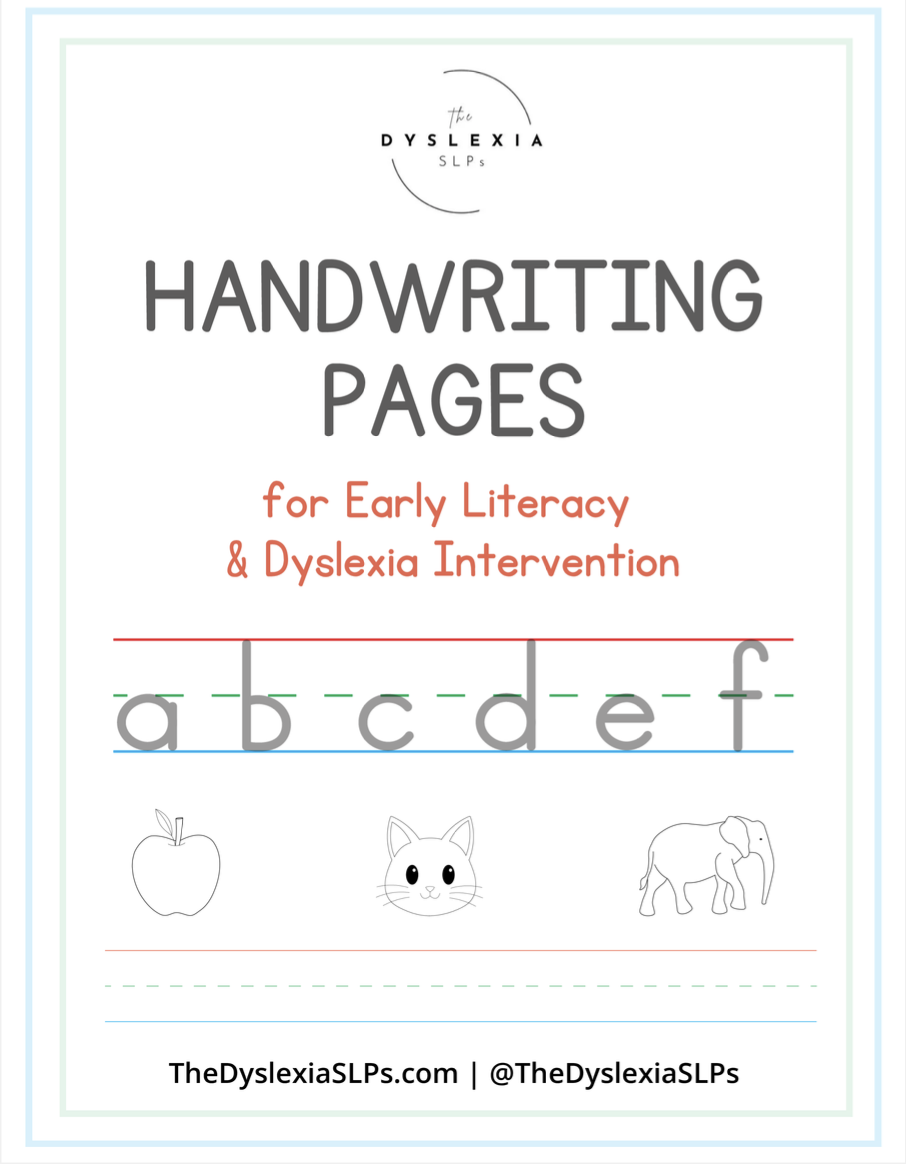
Our handwriting pages make letter formation fun, visual, and easy to teach, especially for students with dyslexia and language-based learning differences. With engaging images and clear visual supports, they help students build strong connections between sounds, letters, and motor patterns while reducing frustration and increasing confidence—making them a perfect fit for SLPs targeting early literacy and handwriting together.
Preliteracy Basics
The activities you need to teach the fundamentals.

Syllable awareness is an essential phonological processing skill that helps students understand that words are composed of individual sounds. Before focusing on individual phonemes, students should first learn to identify and manipulate syllables. Start with compound words, as they are the easiest to segment and blend, and then gradually progress to longer words.
About This Packet
This packet includes 40 cards designed to teach blending, segmenting, and counting syllables. The cards are divided as follows:
· Compound words: 12
· One-syllable words: 4
· Two-syllable words: 12
· Three-syllable words: 6
· Four-syllable words: 6
Suggested Activities
1. Counting Syllables
Encourage students to count the syllables in each word. Use materials such as bingo markers, Play-Doh, or small toys to represent each syllable as they say it aloud.
2. Segmenting Syllables
Practice breaking words into syllables. Ensure students articulate the sounds of each syllable clearly and accurately.
3. Blending Syllables
Play a "secret word" game to practice blending syllables:
· Present 2-4 cards and say each syllable of a target word separately. Ask the student to blend the syllables together to "guess" the word.
· Extension Activity: Hide the target card and challenge the student to blend the syllables without visual support.

Phonemic awareness is an essential skill that is a prerequisite for reading and spelling. Students should be taught to blend, segment, and isolate individual sounds in CVC words. Teach these skills from easiest to most difficult: blending, segmenting, and finally isolating.
About This Packet
This packet includes 25 cards designed to teach blending, segmenting, and identifying individual phonemes in CVC words with short vowels. There are five cards for each short vowel sound (a, e, i, o, u).
Suggested Activities
1. Blending Phonemes
Present cards in a field of two and say the three individual sounds of the target word. Have your student identify the target word by blending the sounds together.
· Extension Activity: Present 3-4 cards at a time.
· Extension Activity: Present cards with similar sounds (e.g., bed and red).
2. Segmenting Phonemes
Have students identify the individual sounds in a target word. Since medial sounds can be difficult to process, you should begin this activity with one short vowel sound (we recommend “a”).
3. Identifying Matching Sounds
In a field of three, have students find a word that has the same initial/final sound as another card. For example, present pot, pen, and cat. Ask, “Which word has the same first sound as pot?” Start with beginning sounds and then move onto final sounds.
4. Identifying Individual Phonemes
Using one card at a time, ask students to identify one sound of the word (first, middle, or last). For example, you could say, “What is the first sound of mop?” Start with beginning sounds, then final sounds, and then medial sounds.

Learning to rhyme is an essential early phonological awareness skill that we teach our preschool students. Since most of our students benefit from explicit instruction, this activity will guide them from recognizing onset-rime patterns to independently generating rhymes.
About This Packet
Included in this packet are: two houses, pictures for -et words, pictures for -ag words, pictures for -at words, pictures for-in words, pictures for -ox words, pictures for -in words.
Suggested Activities
Begin with one house an one set of words. Teach the words and task, because the pictures are not all obvious to children an have them place the words on the windows. Tell them this is my -ag house and all of my words soon like -ag.
Do this again but this time teach the task. Say, “W -ag makes the word ____. That’s right all of my words soon like -ag. Let’s do another b -ag makes the word ____. “
Find the one that doesn’t belong. Have the child close their eyes. Put one -et word on one of the windows and the rest -ag words. Go through all of the words, w -ag, b-ag, r -ag, v -et. Ask which one doesn’t sound like -ag
Keep practicing steps one through three until the child gets it. When ready move on to sorting between two houses. Make sure to start with sounds that are different so they don’t get confused. Start with the sets that are printed together on the same page.
Step-by-step guides
Everything you need to teach reading and spelling.
This literacy guide is designed for preschool and early elementary students (ages 4-7) who have been diagnosed with dyslexia or identified as at risk and who lack the phonological awareness skills necessary to begin learning to read and/or spell. These are the students who often face significant reading challenges, making early identification and intervention critical.
We believe it is essential for pediatric speech-language pathologists to be vigilant in identifying dyslexia and to incorporate literacy into their practice. Early literacy intervention is not only highly effective—it is engaging, rewarding, and powerful to witness as students begin mastering foundational skills that support long-term reading success.
This guide is appropriate for:
Students diagnosed with or at risk for dyslexia
Preschoolers who need explicit phonological awareness instruction before reading
School-aged students who lack basic phonological processing skills
Skills Covered
Rhyming – Identifying and producing rhyming words
Syllable Counting – Counting, segmenting, and blending syllables
Beginning Sounds – Recognizing and matching initial phonemes
Phoneme Blending – Combining sounds to form words
Phoneme Segmentation – Breaking words into individual sounds
Phoneme Manipulation – Adding, deleting, or substituting sounds
Letter–Sound Correspondence – Connecting letters with their sounds
To support early identification, we encourage clinicians to utilize our free Dyslexia Screener, available on our website, to help determine which students would benefit from this intervention.
Coming Soon! Literacy Guide: Step One